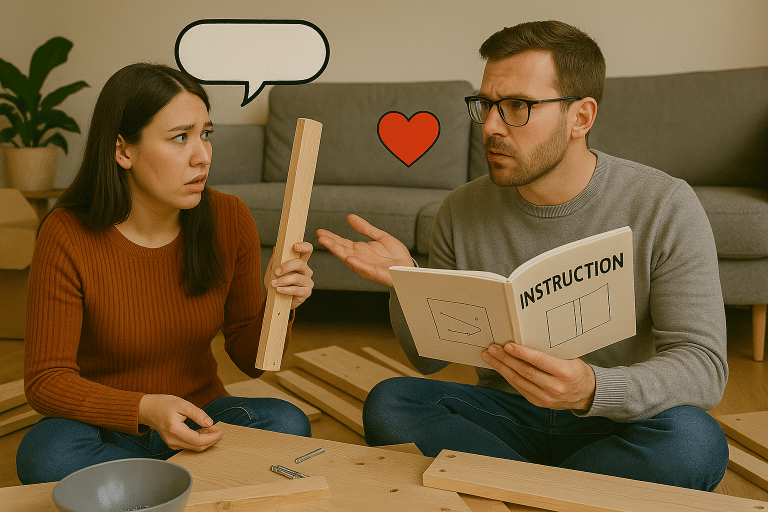
If you asked most married couples what they fight about, you’d hear a version of the same list. Communication. Money. The kids. The in-laws. Who’s doing more around the house. Who texted whom back and how long it took. Sex. Time. Energy. The way one of you loads the dishwasher.These are real things. They cause real pain. But if you’ve been married for a while, you’ve probably noticed something strange about them. You can resolve the dishwasher conversation, and a week later it’s the dishwasher again. You can divide the chores fairly, and somehow you still end up frustrated. You can talk about money for the tenth time and still feel like you’re living in two different financial universes.This is one of the most common realizations of long-term marriage. The fights you keep having aren’t really about what they look like they’re about. They’re about something underneath, something most couples never quite get to, because the surface argument is so loud and so familiar that it pulls all the attention.If you’ve ever ended a fight thinking, how did we end up here again, this piece is for you. When researchers and therapists who specialize in couples work look closely at long-term marriages, the same pattern keeps showing up. Most ongoing conflicts in a marriage aren’t really about the topic on the table. They’re about the difficulty of being two genuinely different people sharing one life.This sounds almost too simple. But it’s worth sitting with, because it changes everything.You and your spouse came into this marriage shaped by entirely different families, different childhoods, different cultures, different sets of unspoken rules about how a home should run, how feelings should be handled, how love should be expressed, how conflict should be approached. Most of these rules you absorbed without anyone ever explaining them to you. They feel less like rules and more like reality. This is just how things are done.Then you married someone whose reality is, in dozens of small ways, different from yours. They load the dishwasher wrong. They want to clean up before guests leave; you want to sit on the couch and chat first. They process emotions out loud; you process them in silence. They want to talk through every feeling; you want to take a walk and come back when you’ve sorted it out. They grew up in a house where everyone yelled and meant nothing by it; you grew up in a house where raised voices meant something terrible was about to happen.When two people with different inner worlds bump into each other, in marriage that bumping happens constantly. And what most of us do, without realizing it, is treat the difference as a problem to solve. Specifically, a problem in which one of us is right and the other is wrong.This is the move that turns a difference into a fight. The fight isn’t really about the dishwasher. It’s about whether your way of doing things is allowed to keep being your way. It’s about whether the version of life you grew up inside still gets to exist now that you’re sharing a life with someone whose version is different. There’s a tender layer underneath this that often goes unnamed in marriages, and it’s worth saying out loud.When your spouse does something differently from how you’d do it, part of what gets activated in you isn’t really about them at all. It’s a quiet loyalty to the people who raised you. To the family system you grew up in. To the way your mother kept the kitchen, or the way your father handled disagreements, or the unspoken values your family lived by.Letting your spouse’s way be valid can feel, at some level you might not even be conscious of, like a small betrayal. Like you’re saying the way you grew up wasn’t the only right way. Like you’re letting go of something that has held you together your whole life.This is part of why even small differences in marriage can land so hard. The dishwasher isn’t really the dishwasher. It’s a piece of your identity, your history, your sense of who you are and where you come from, suddenly being asked to share space with someone else’s identity, history, and origins.When you understand this, a lot of marital conflict starts to make a different kind of sense. The reason you can’t just get over it isn’t that you’re petty. It’s that the conflict is touching something much deeper than the surface. The couples who navigate this well aren’t the couples who agree on everything. They’re the couples who, over time, stop trying to win the difference and start trying to understand it.This is one of the most consistent findings in the work of researchers like Dr. John Gottman and Dr. Sue Johnson. Strong marriages are not marriages without conflict. They’re marriages where both partners have learned, slowly and imperfectly, to hold a different stance toward conflict. A stance that goes something like this: we are two genuinely different people, both of whom are valid, both of whom matter, and our job is not to figure out who’s right. Our job is to figure out how to build a life that honors both of us.This sounds gentle. In practice, it’s actually quite demanding. It asks you to loosen your grip on being right. It asks you to consider, even for a moment, that your spouse’s way of doing things might be a real, legitimate way of being human, not a deviation from the obvious correct answer. It asks you to look at your own deeply held convictions and ask whether they’re really truths, or whether they’re just the version of life you happened to grow up inside.This is why marriage, when it’s working well, is one of the most growth-producing relationships any of us will ever have. It refuses to let us stay safely tucked inside our own assumptions. Here’s a reframe that helps a lot of couples in long-running fights. The conflict you keep having isn’t a sign that something is wrong with your marriage. It’s information about something inside one or both of you that’s asking to be looked at.When you find yourself disproportionately upset about something small, that disproportion is the clue. It’s almost always the case that the small thing is touching a much bigger thing underneath. Maybe it’s reminding you of something from your childhood. Maybe it’s activating an old fear you carry about being unseen, or unimportant, or alone. Maybe it’s bumping up against a value that’s deeper than you realized.When couples slow down enough to ask, what is this fight really about for me, they often find something they didn’t expect. The fight about the dishes turns out to be about feeling like the only adult in the house. The fight about money turns out to be about a fear of not being safe. The fight about the in-laws turns out to be about feeling like a guest in your spouse’s life rather than an equal partner in it.When you can name the deeper thing, the surface thing usually loosens its grip. Not because the surface thing doesn’t matter, but because once both of you know what’s actually being asked, the conversation can happen at the right level. If there’s a fight you and your spouse keep having, try this before the next round of it.Ask yourself, in a quiet moment by yourself, what is this really about for me. Not the version that argues your case. The version that’s underneath.If it helps, try finishing one of these sentences. When this happens, what I really feel is… The thing I’m actually afraid of is… What this reminds me of is…You may be surprised by what comes up. The honest answer is almost always softer than the version you’ve been bringing to the fight. And the honest answer is usually the version your spouse can actually hear.If you can, share what you find. Not as an accusation. As an offering. I think I figured out something about why this keeps coming up for me. Can I tell you?That kind of sentence has changed more marriages than any communication technique ever has. Because it stops being an argument about the dishes and becomes a conversation about the two of you. This kind of shift is one of the most powerful changes a marriage can make. It’s also one of the hardest, because the fights you keep having have momentum, and the moment you’re inside one is the worst possible moment to suddenly become wise about it. Most of us can see the pattern clearly the day after. In the moment, we’re just inside it.This is part of why couples therapy exists, and why approaches like Emotionally Focused Therapy and the Gottman Method have become so widely used. A skilled therapist doesn’t take sides. They help both spouses slow down enough to see what’s really happening, name what’s underneath the surface argument, and practice talking to each other from that deeper place rather than from the familiar one.Many married couples find that the move from the same fight on repeat to a real conversation about what’s underneath it happens more easily with the guidance of a therapist who can hold the space while both partners say things they haven’t quite been able to say on their own.If you’ve been carrying the quiet exhaustion of having the same argument over and over, please hear one thing. The fight isn’t proof that something is broken between you. It’s an invitation, often a stubborn one, to know each other more deeply than you have so far.The couples who go the distance aren’t the ones who never disagree. They’re the ones who learn, slowly and imperfectly, to treat their differences not as evidence of incompatibility, but as the most honest doorway into who they each really are. And on the other side of that doorway is something most marriages never quite reach, but every marriage is capable of reaching: a closeness built not on similarity, but on being truly known.What’s Really Underneath the Fight
How Your Family of Origin Impacts you Both
The Solution
What the Conflict Is Often Trying to Tell You
Something Small to Try
When It’s Hard to Do This Alone

When you Can’t Shake off the Feeling of Being Jealous: What It’s Actually Telling You, and How Couples Can Work With It
Jealousy is often described as if it were one thing, but in practice it is