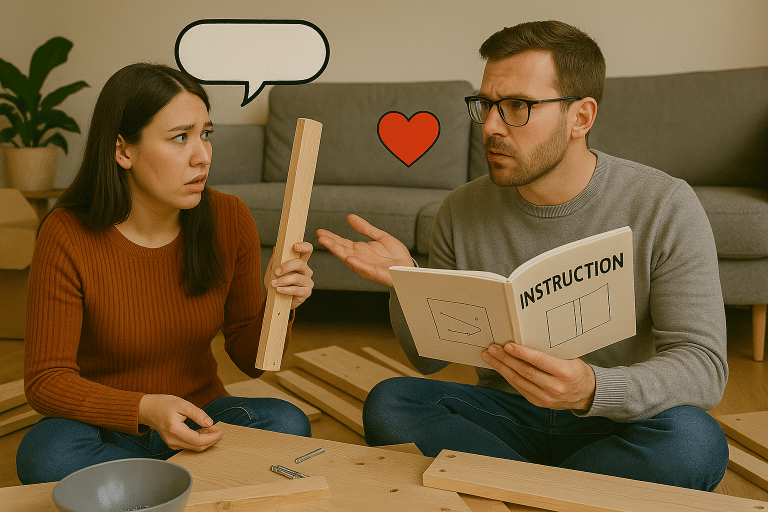
When thinking about ADHD, we often think about focus, forgetfulness, or difficulty staying organized, but in relationships, ADHD doesn’t just show up in tasks, it shows up in how to connect.
What I often see in couples work is not just ADHD, but the cycle that forms around it. One partner reaches, the other misses it. One reacts, the other withdraws. Slowly, both people begin to feel alone in the relationship.
If you or your partner has ADHD, here are five ways it may be shaping your relationship and keeping you stuck in a negative cycle.
- “You’re not listening to me” = “I don’t matter to you”
One partner may feel hurt or unimportant when the other forgets conversations, gets distracted, or seems mentally elsewhere. From the outside, it can look like disinterest, but underneath, this often lands as something much deeper:
“I’m not important enough for you to stay present with me.”
And for the partner with ADHD, there’s often another meaning:
“I’m trying, but I keep getting it wrong.”
Now we have a cycle. One partner pursues for connection, and the other begins to shut down or feel defeated.
This isn’t about not caring. It’s about a missed connection that both partners are reacting to in different ways.
- The shift from partners to parent/child
Over time, one partner may start taking on more responsibility; reminding, organizing, keeping things on track. The other partner may feel micromanaged, criticized, or like they can’t quite “measure up.” What begins as support can slowly turn into resentment on both sides.
Underneath this dynamic you often find:
- One partner thinking, “If I don’t do it, it won’t get done.”
- The other thinking, “No matter what I do, it’s not enough.”
This erodes the sense of being a team,
This isn’t about one partner being “irresponsible” and the other being “controlling.” It’s a protective pattern that pulls you out of connection into roles.
- Escalation happens quickly and feels bigger than the moment
You might notice that small moments turn into big reactions. A forgotten task, a missed detail, or a tone shift can suddenly escalate into conflict that feels disproportionate.
For many individuals with ADHD, emotional responses can feel intense and fast-moving. The nervous system gets activated quickly. But the partner on the receiving end may experience this as:
“Why is this such a big deal?”
And not both partners feel unsettled; one overwhelmed, the other confused or cautious.
The intensity isn’t random. It’s often connected to deeper attachment fears of not being enough, of failing, of being rejected.
- The same arguments keep coming back
Many couples describe feeling stuck in the same conversation on repeat; chores, time management, follow-through, etc. and both partners feel exhausted by it.
From an attachment perspective, this is often where we see the cycle fully take hold:
- One partner pushes for change
- The other feels overwhelmed or shuts down
- The first partner pushes harder
- And around you go
Underneath, both partners are trying to get a need met, but neither feels successful.
The problem isn’t the chore or task, its the pattern you get pulled into when it doesn’t go as hoped.
- Disconnection grows quietly over time
This is often the part that brings couples into therapy. Not the ADHD itself, but the distance that forms around it.
One partner may begin to feel alone, carrying more than they want to. The other may feel like they are constantly falling short or being evaluated. Slowly, both partners stop reaching, not because they don’t care, but because it starts to feel unsafe or pointless.
Disconnection isn’t a failure, it’s often a sign that both partners have been trying to project themselves for a long time.
A different way to see it
When ADHD is part of a relationship, it’s easy to get stuck in content:
- “Why didn’t you do this?”
- “Why can’t you just remember?”
- “Why does this keep happening?”
But underneath those questions are often more vulnerable ones:
- “Do I matter to you?”
- “Am I enough?”
- “Are we okay?”
When couples begin to slow down and look at the cycle, something shifts. Instead of seeing each other as the problem, they begin to see the pattern they are both caught in. From there, they can start turning toward each other again.
A question to reflect on
Next time something feels frustrating or disconnecting, pause and ask:
“What is happening between us right now and what might each of us be feeling underneath it?”